Another night you go to bed telling yourself that you’re going to wake up early and finally do everything that you’ve been meaning to get done the past few days, weeks and even months. But when the morning comes, you sleep in later than expected or you’re busy figuring out which tasks to do from your never-ending mental to-do list. TBH, I don’t think the issue affecting your productivity is the time you’ve been waking up or the length of your to-do list.
It’s that you don’t have a realistic plan!
Being realistic is scary because it forces you to come to terms with your limitations as a human being!
Whether you’re the eldest child, a stay-at-home wife, a single parent, a working dad, someone with disability, someone commuting long hours or someone with financial and family responsibilities, there are only 24 hours in a day. This is hard to accept. I know because I’ve been there. You think you can do it all. The hard reality is you can’t!
No matter how many self-help books you read on productivity and whatever new hack a productivity expert has suggested in their YouTube video, the truth remains that there are simply too many tasks to be done with too little time. So, the only way to get things done is to plan accordingly and realistically with the expectation that you will never get to complete everything on your to-do list.
Before I jump into my step-by-step guide to get through your busy days, here is my morning mantra:
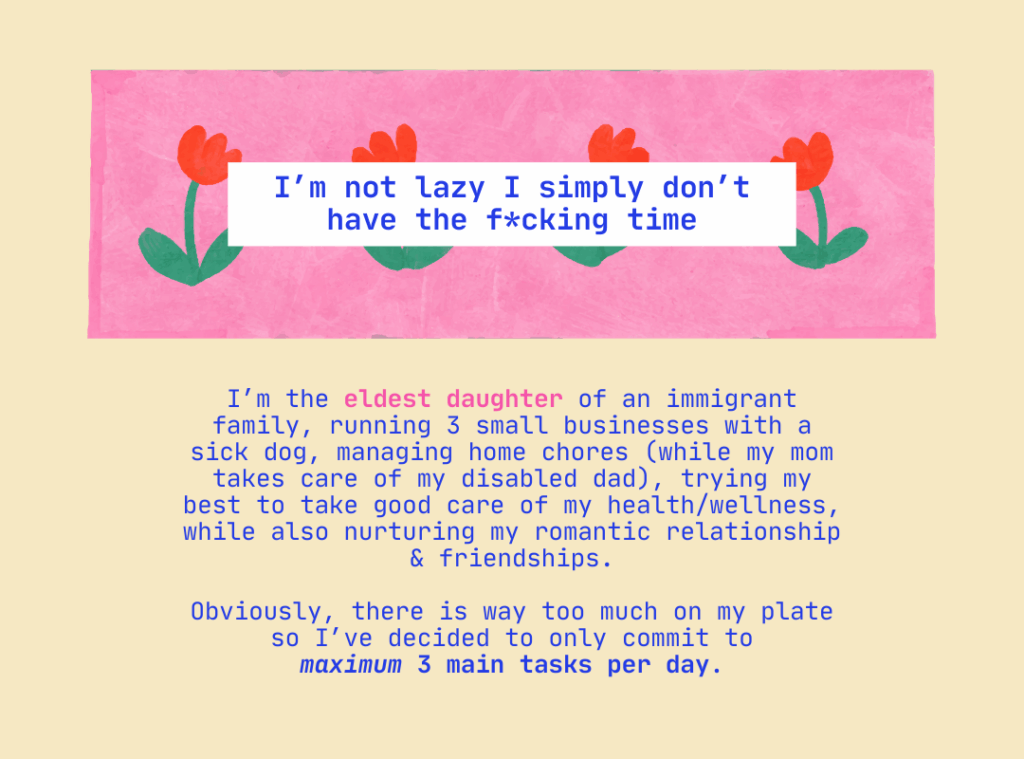
When you’re grounded in your own reality, it’s easier to stop comparing yourself to someone who might be operating with more time, support and resources than you.
Not everyone’s playing field is the same.
Now, here is a mini-guide on planning a productive day:
1. Prep the night before

If you wait to plan the day of, you’ll actually waste time the next day purely on planning.
Again, excessive planning is a form of procrastination.
Again, planning isn’t doing.
Lay out clothes or prep your workspace ahead of time.
I hate going to the gym and it’s the bane of my existence (I am not even exaggerating…okay maybe a little). So, I try to lay out my clothes and pack my bag the night before to prevent myself from flopping. I know this seems like a simple task but it’s the small decisions that will help you with bigger choices. I often find that fitness is a mental battle more than a physical one. I can come up with so many excuses to not workout but once I get started, movement becomes that much easier.
If you’re a student preparing for exams, pack your bag, create an exam study schedule and even pick out a comfortable outfit for your study session the night before. Don’t just say you’re going to study. Be very specific as to the subject(s) you will be studying, the chapters you will be reading and even the practice questions you want to complete. I am not saying list every small detail you need to do but have a clear vision as to what needs to be done for your productive day.

2. Brain dump lingering to-dos
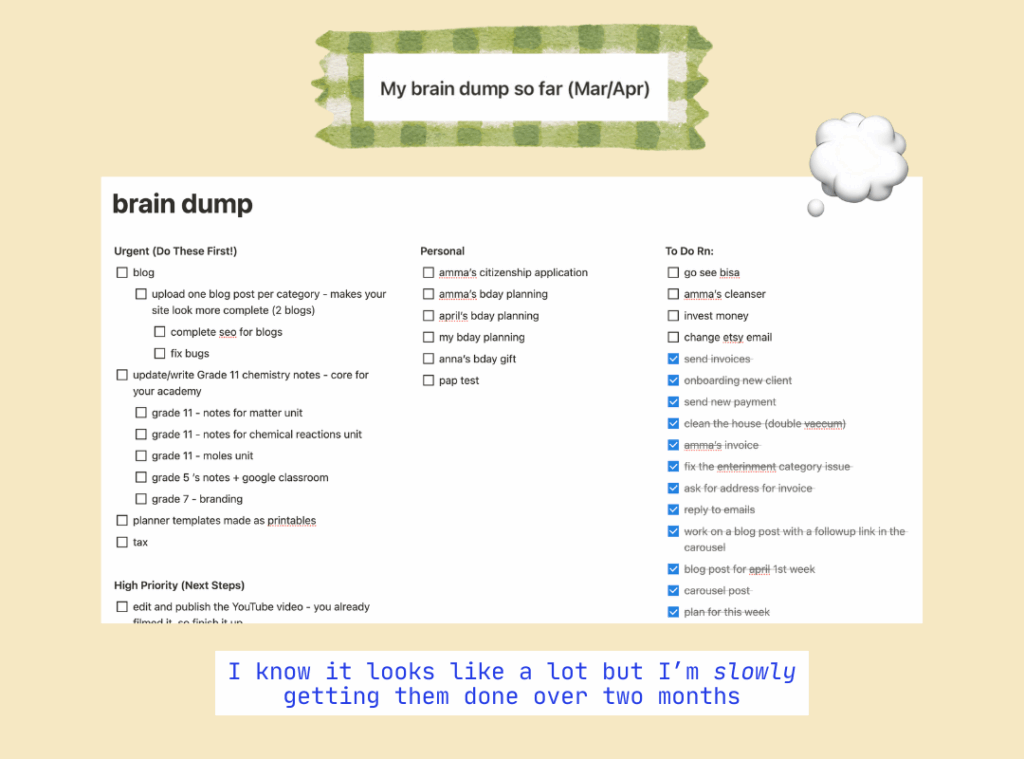
Just like many people, I love the feeling of ticking off the checkbox. I am always eager to write down even the most obvious things I was going to do anyway so that I can feel as if I’ve accomplished something at the end of a simple task when I crossed it off from my to-do list. But overtime, the issue with this approach is I became bad at prioritizing the tasks that needed to be completed first.
So, the solution I came up with was creating a brain dump list—a long and chaotic list of every task that I want to get to and is weighing me down as mental clutter. After giving these lingering tasks in my head a physical form as a brain dump list, it was easier to organize my thoughts and my action plan.
Next, I categorize each of the tasks into one of the 5 following categories ordered from highest to lowest priority:
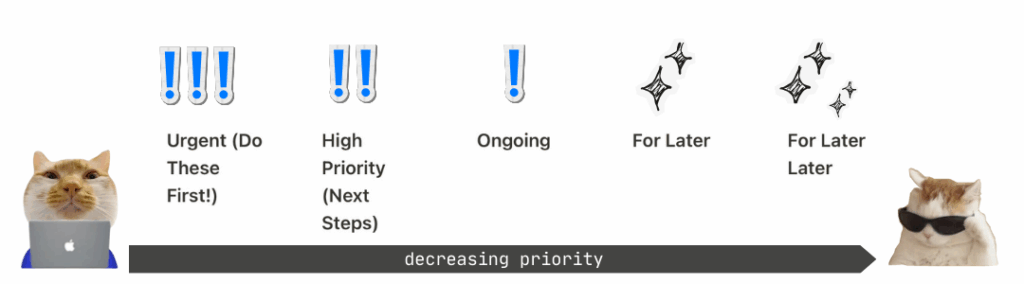
I suggest you use Notion or some sort of digital planning for this so that you can drag and drop each item from the brain dump lists under the appropriate section.
Sometimes, I don’t even know what is of higher priority. When I’m overwhelmed by the number of things on my brain dump list and struggle with prioritizing tasks, I use the Eisenhower Matrix—a decision-making tool designed to help you focus on what matters and ditch what doesn’t.
The Eisenhower Matrix (also called the Urgent-Important Matrix) was inspired by former U.S. President Dwight D. Eisenhower, who famously said:
“What is important is seldom urgent, and what is urgent is seldom important.”
It divides tasks into four quadrants based on two simple questions:
- Is it urgent? or
- Is it important?
3. Pick 3 MITs (Most Important Tasks)
Once you have your brain dump organized, now you can start building a plan!
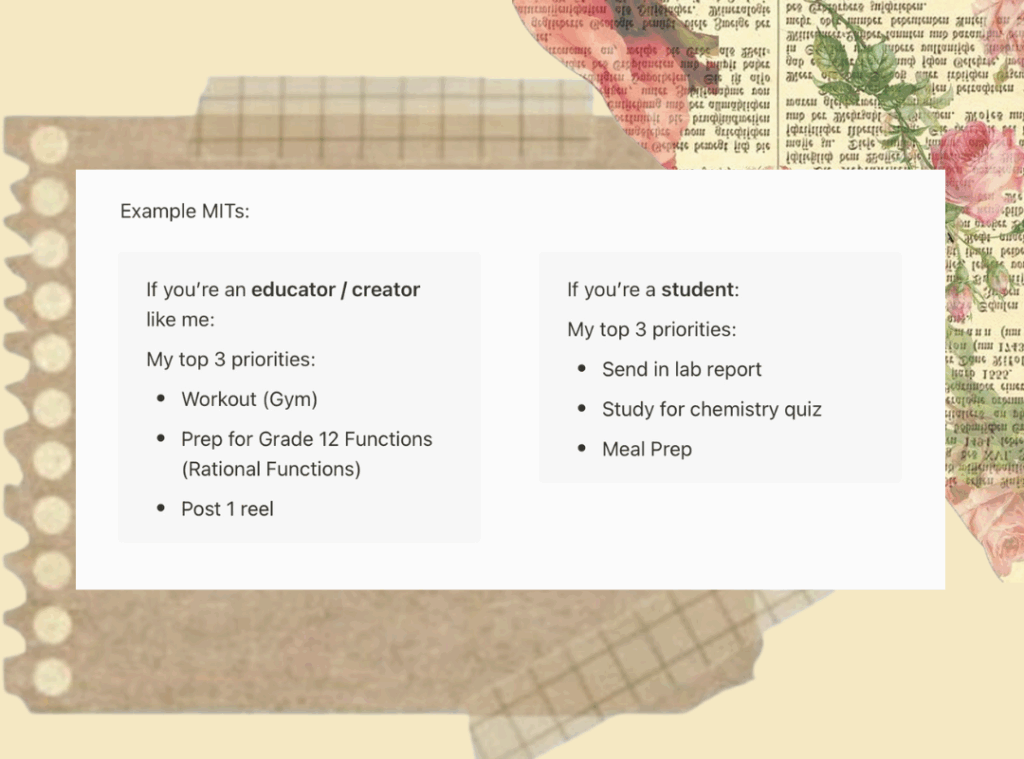
Pick three key things that would make the day feel successful, even if nothing else gets done.
I usually choose 3 priorities because I simply can’t imagine myself getting more than 3 things done considering I’m the eldest daughter of immigrant parents running multiple small businesses while trying to maintain a slow and meaningful life in rhythm with my community.
Here is how I align my priorities in no particular order. I try my best to get these tasks done but even this is difficult if any family related commitments show up.
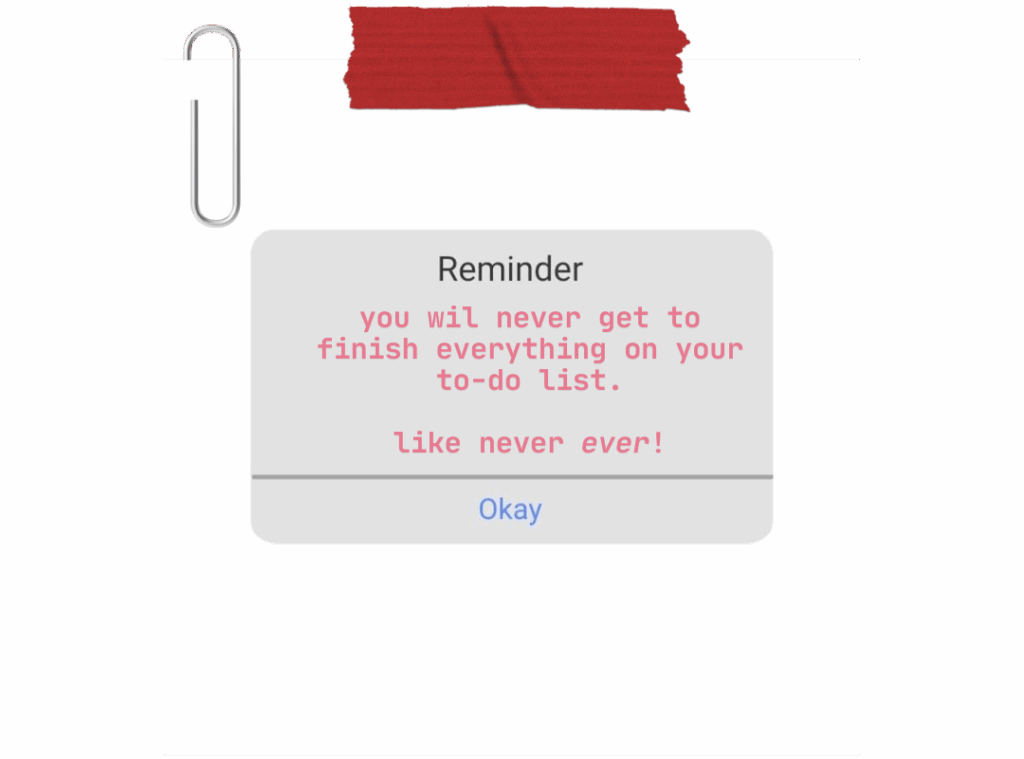
Remember, YOU WILL NEVER GET TO EVERYTHING ON YOUR TO-DO LIST! (Like never, ever!) Stop romanticizing the end. Focus on the process instead.
4. Create a plan
Once you have your 3 MITs, then check if you have any important events or deadlines (meetings, assignments, projects, tests) that need to be blocked off since these are not adjustable!
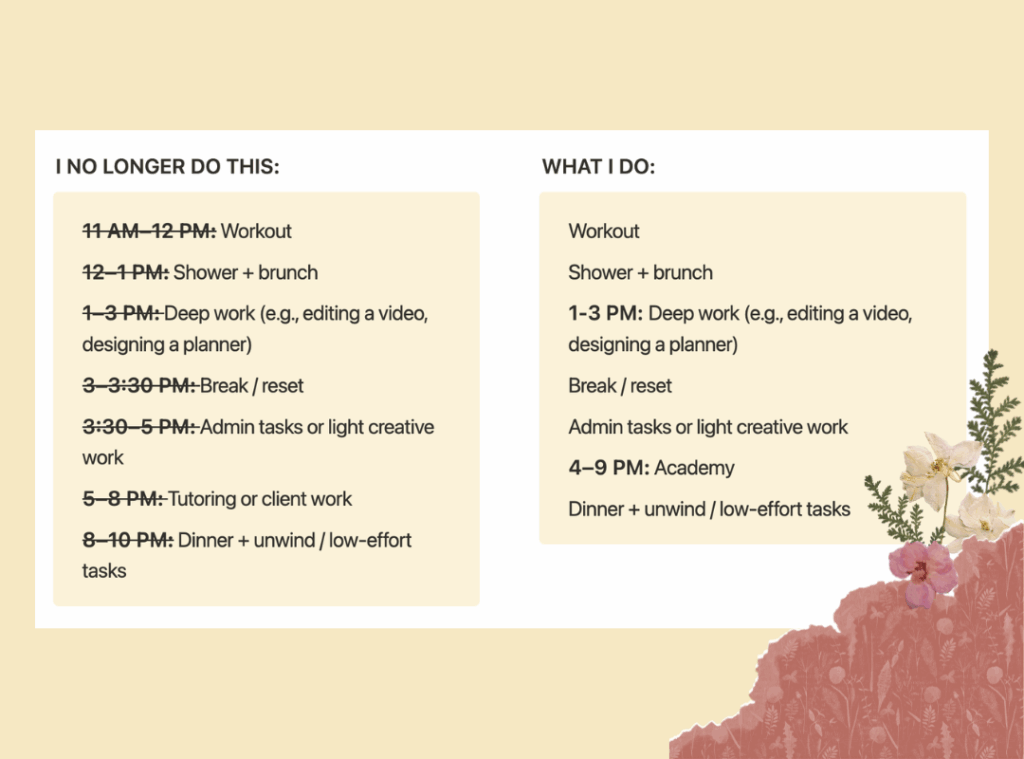
I no longer follow time-stamped routines. It simply doesn’t work for me and in fact it just adds more stress because I have the urge to stick to a time and when things take longer than expected, I start spiraling.
LET THINGS TAKE THE TIME THEY TAKE!
Instead of “Be awake, rest and sleep at a specific time.” just do what comes naturally to you in the order they come.
After you block off meetings, scheduled classes and events, you then have the rest of the time to play around with.
How I plan my days without excessive time blocking:
5. Build in breaks & buffer time
Don’t overstuff your day. Leave room for life to happen which is why I have only 3 MITs and even getting this done is rare on most days. I often get to finish 2 of the 3 MITs because I simply don’t have the time.
From your MITs, one of them should include wellness (gym/meal prep) because if your health is sh*t what’s the point of working?
If you’ve been following my content for a while, you can see that I no longer value productivity in the way I used to because I would regularly sacrifice my mental and physical health to get things done.
I’m at a point in my life where the quality of my day-to-day matters more to me than any job title, prestige or paycheck. A big part of this is because I’m unmarried, child-free, and living with my parents—which gives me the privilege to walk away from opportunities that interfere with my well-being. I know this isn’t possible for everyone. So if things like going to the gym or meal prepping feel out of reach right now, I hope you’ll still try to do one small, kind thing for yourself every day. Make that your non-negotiable MIT.
6. Use only a few tools
I know there are many apps and planners out there that seem more useful than the app you’re using. However, I encourage you to simplify the number of tools you use for planning to limit distraction and spending too much time on planning instead of doing.
Here are some of the tools I use for planning:
- Notion for bigger planning
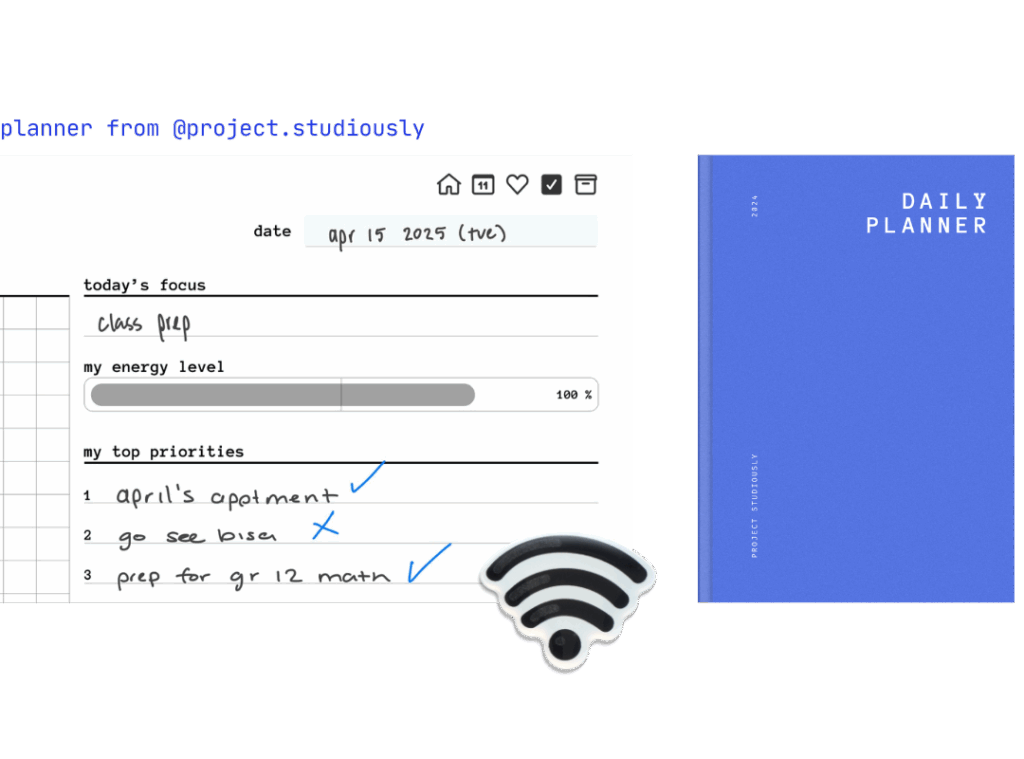
- My digital planner (from @Project.Studiously) to schedule and check off tasks day-to-day and monthly lists
- Physical tracker for visual satisfaction (crossing off feels so good) – I only do this for fitness because I hate working out!
I hope you found these tips realistic, relatable and helpful. Life is not a race. Do things slowly. I hope to see you next week!